Play for 11

Hours, days, weeks, and months of preparation culminate tonight as we turn the page from pre-season, to begin a new chapter: “In Season.” The Vermont high school football season kicks off tonight at 6:00PM on the campus of St. Johnsbury Academy as we welcome our rivals from down Interstate 91 the Hartford Hurricanes.

While today is but another day on the calendar, it’s one we’ve all waited for with anticipation. Coaches, players, parents, faculty, and staff alike have sacrificed their time, talents, and treasure to help our team prepare for tonight’s game and the start of this year’s season. Individual and collective skills… lessons in character… teambuilding… efforts to foster a culture of interdependence, and a belief in something bigger than ourselves…

Tonight we step on the field with a common vision of who we are and want to become. Common values: a belief in each other, and a belief in our team. A shared sense of purpose, and a belief in what we together, can achieve.

On our locker room board, we have a sign with our motto… “Play For 11.”  It is a daily reminder for our players to play for the 11 on the field and never for themselves.  To practice every day to be one of the 11 on the offense, defense, or any special team depth chart. To play for the 11 letters in St Johnsbury, our town.  To play for the 11 letters in Hilltoppers, our team name.  To play for 11 games which would have us in the championship game.  And to play for 11 wins making us undefeated state champions.  

Tonight marks an important step on our journey; a journey not to be taken lightly, and one best taken together. “Play for 11.”

Coach Rich Alercio is available to discuss coaching philosophy, X’s & O’s, or teach his O-Line “techniques in the trenches.” Contact Coach at richalercio@gmail.com and share http://www.olineskills.com with your colleagues and friends. Thanks for supporting this blog and joining our conversations, and as always, thanks for your time!

The First Follower

Coaches always stress the importance of leadership and the development of team leaders.  I tend to follow a definition stating, “Leadership is the sum of those qualities of intellect, character, and interpersonal skills enabling an individual to guide a group of people to successfully achieve a goal.” It is inarguable that strong leadership is critical to the success of any team, and personal example is one of the strongest attributes of a good leader. 

At the same time, it is also critical to develop followers.  Followers, especially the first follower, reinforce the leader’s example, and by doing so, set an example of their own.  Like the leader, he or she will stand out and is vulnerable to questioning and perhaps even ridicule by the group.  The first follower transforms the leader’s lone idea into a group’s thought, and at the same time makes it acceptable for others to join and follow as well.  The first follower is key in starting any movement, changing, or reinforcing any culture.  

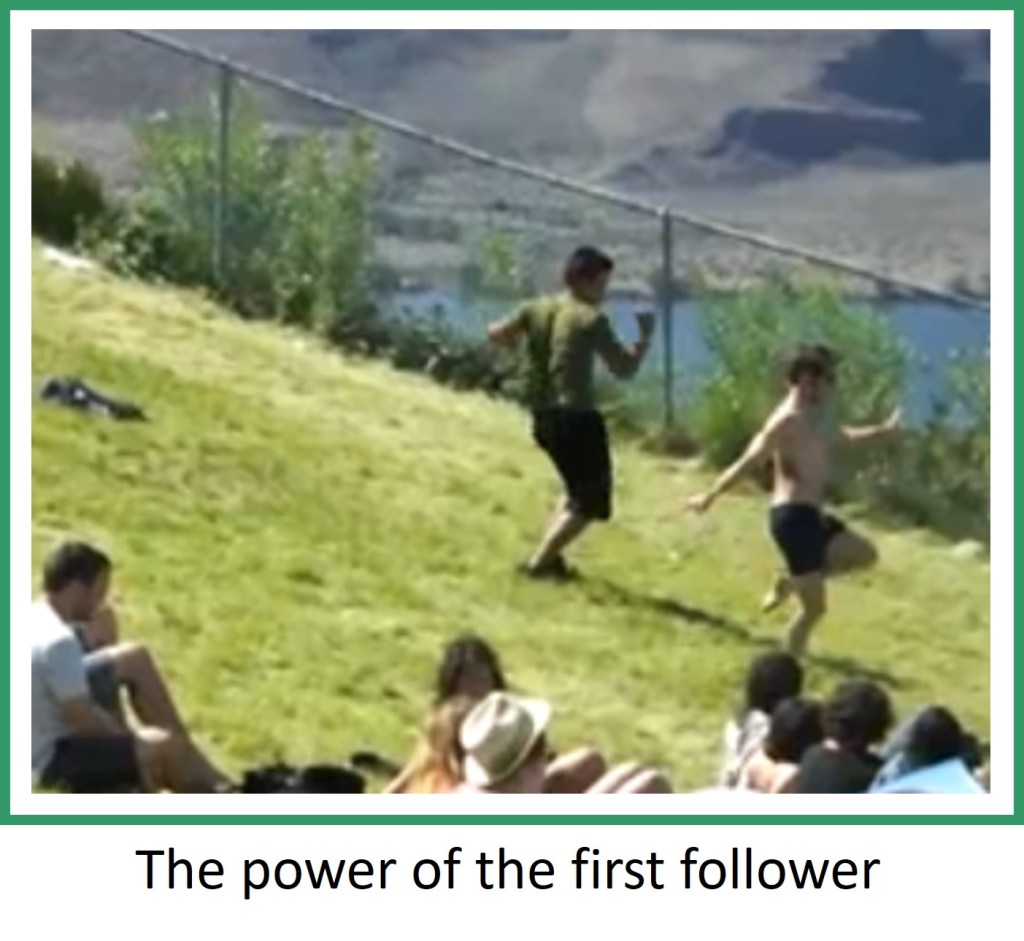
The picture here includes a link to Derek Sivers’ video and discussion of the first follower’s power.  In it, you will see a lone dancer in a field at a music festival who appears to be ostracized or at least segregated from those around him.  When one person shows the courage to join him, it opens the door for others to follow.  The first follower emulates the leader and makes the leader’s actions acceptable to others, and in turn, creates a movement.  At the same time, take note of the leader’s response to the first follower; he welcomes him and makes it about “them” rather than about him.  In doing so, he demonstrates the importance of the team, builds trust, and together the leader and first follower create an atmosphere many others find inviting. The first follower is an often underappreciated form of leadership.  

Coach Rich Alercio is available to discuss coaching philosophy, X’s & O’s, or teach his O-Line “techniques in the trenches.” Contact Coach at richalercio@gmail.com and share http://www.olineskills.com with your colleagues and friends. Thanks for supporting this blog and joining our conversations, and as always, thanks for your time!
Team Building & Interdependence

During the weeks of training camp, coaches teach players the plays, schemes, and techniques they need to know in order to have success during the season.  But, more importantly, coaches are developing a team that will work together to accomplish the mission.  

During the year I was born, 1965, psychologist Bruce Tuckman came up with the development sequence that describes the path a team follows on their way to high performance.  He labeled the four stages of team development: forming, storming, norming, and performing.

The “forming” stage is the beginning when a new team is formed.  Individuals will be unsure of the team’s purpose, how they fit in, and whether they will work well with one another.  Players will be anxious, curious, and excited to get going during this stage.  They will be looking to the team leaders for direction, and coaches need to be clear, concise, and candid in their directions and expectations.

Next comes the “storming” stage when conflict or friction can arise between team members competing for positions on the depth chart or with team leaders as they challenge their authority.  Left unchecked, this can lead to confrontations and simmering tensions.  This stage can make or break a team. Again, as coaches, we are responsible for reinforcing expectations and aligning behaviors toward the culture we want to create.

When properly guided through the storming stage, the team moves into the “norming” stage.  People start to resolve their differences, appreciate one another’s strengths, have more respect for team leaders, and begin to work together with a shared commitment to the team’s goals. The elements of culture we’ve been working on all spring and through summer OTAs are becoming natural and common. 

When teammates develop a common purpose, common vision, common values, and common goals, we enter the “performing” stage where differences among members are valued and used to enhance team performance to work at its full potential. We’ve grown to become interdependent, value each other’s contributions, and demonstrate proficiency at the scale of the team. As Coaches, we look to reinforce the very best aspects of teamwork, camaraderie, character, and culture.

As stated in previous blogs, we do not end our last practice of each day with a demoralizing conditioning drill that has little translation to increased athletic and team performance.  Rather, we play full-speed team-building games requiring athletes to work together, use strategy, and make good decisions while they are running, changing direction, accelerating, and decelerating.  They are working through Tuckman’s phases, getting conditioned, and increasing athletic performance without even knowing it.  They think they are just playing and having fun.  As playing football should be.

Coach Rich Alercio is available to discuss coaching philosophy, X’s & O’s, or teach his O-Line “techniques in the trenches.” Contact Coach at richalercio@gmail.com and share http://www.olineskills.com with your colleagues and friends. Thanks for supporting this blog and joining our conversations, and as always, thanks for your time! 

A Little Encouragement Goes A Long Way

When you work any type of construction job and use a power tool with an extension cord, you learn to tie the two together so that they do not become disengaged.  If the tool is not connected to the power source it will not work, and the job cannot be accomplished.  

People are the same way.  They need to be connected or engaged in order to do the work and get the job done.  A Gallup Poll of employee engagement divided workers into three categories: engaged, disengaged, and actively disengaged.  Those who were engaged cited employee recognition as the number one driver of engagement.  It is the best way to make people feel valued and to motivate them to give their all.  And that recognition can come in a variety of ways.  I remember my first training camp as a college football player and running a play vs our starting defense.  It was a Swing Screen that had me pass set then sprint out down the line of scrimmage to lead for a delayed swing of the running back out of the backfield.  The Safety filling the alley never saw me coming and it was the type of block you usually only dream of.  As I excitedly returned to the huddle, I was met with a hug from our OLine Coach, a high-five from our Offensive Coordinator, and a stare coupled with nods of approval from our head coach.  

To be very candid, during that first week of 3-a-days, I was contemplating what I was doing there and questioning my ability to ever play college football.  I was low on the depth chart, recovering from a season-ending injury and three surgeries between high school and college. Quite candidly, given all I had endured, it was difficult seeing a path forward.   That Gallup Poll would have categorized me as disengaged.  Then that Swing Screen was called and those coaches gave me what I had longed for, recognition which led to a feeling of connectivity.  Four weeks later, I made my first college start.  Two years later, I was voted a team captain.  That play and those coaches’ reactions turned the tide of my college career.  

Some of you may recall the comedic commercials of “Terry Tate, Office Linebacker.” Thankfully we don’t see the kinds of hits I put on that safety unless it’s a spoof like Terry Tate, but we do see folks in all sorts of offices, worksites, or other scenarios doing their jobs every day. In some cases, though an otherwise mundane task, our recognition of their efforts has the potential to shift their mindset the way my coaches shifted mine. Thanking the cleaning crew for keeping the office neat and clean, thanking the lunch lady for serving with a smile, or anyone else doing a job well that might otherwise be taken for granted. Hugs, high fives, pats on the back, nods of approval, and words of affirmation can all be quick and easy ways to give employees or team members the recognition they need to feel engaged and get the job done.  

Coach Rich Alercio is available to discuss coaching philosophy, X’s & O’s, or teach his O-Line “techniques in the trenches.” Contact Coach at richalercio@gmail.com and share http://www.olineskills.com with your colleagues and friends. Thanks for supporting this blog and joining our conversations, and as always, thanks for your time! 

R&R, & Life Long Learning

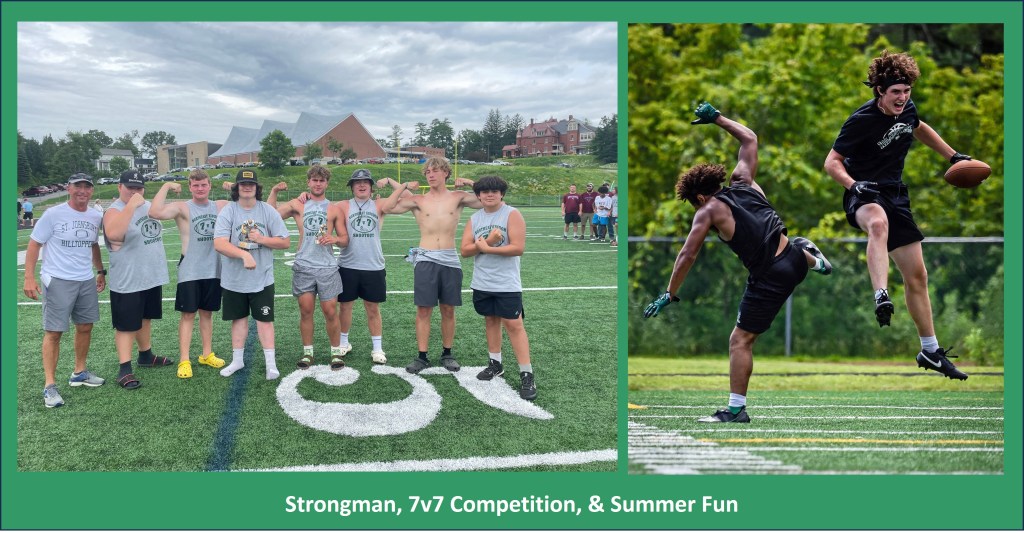
With our 7v7 Tournament, Strongman Competition, and OLine Challenge behind us, we enter Vermont’s mandatory Dead Period prior to the start of Training Camp on Monday 14 August.  Although the colloquialism of “Dead Period,” is quite common, I’d rather refer to it as Rest and Recovery Period. For 35 years, I have always taken the last week or two before Training Camp to enjoy vacation time, travel, and visit family.  This year will be no different.  

While “recharging my batteries,” the other thing I typically do is read.  Generally speaking, I do not read for pleasure but rather for professional development.  Sometimes coaches who fall into the realm of “long-time veterans” feel they have all the requisite knowledge and need not read more on coaching.  I do not fall into that category and would like to think I’m a lifetime learner.

When I’m asked about suggested readings, I always offer “The Boys in the Boat,” by Daniel James Brown.  While it is not a football book, there is much to learn about the importance of teamwork, resilience, and coaching.  If the request is for a football book, I recommend Bill Walsh’s, “The Score Takes Care of Itself.”  

I recently had the pleasure of meeting and spending some time with Dr. John Alder, Head of Player Development for Welsh Rugby Union.  When I asked him for suggested readings he offered: “Tyranny of Talent,” by Joseph Baker, “The Coaches Guide to Teaching,” by Doug Lemov, and Sebastian Junger’s, “Tribe.”  I started reading “Tribe” this week.  In the top right-hand corner of the whiteboard in my office are written the words “Culture Trumps Everything.”  Junger’s book is teaching me why that is more important than ever.  And so I’ll rest, recover, read, and learn in order to be best prepared to begin the 2023 season. When staff and players return at the end of these two short weeks, culture will underpin everything we do.

Coach Rich Alercio is available to discuss coaching philosophy, X’s & O’s, or teach his O-Line “techniques in the trenches.” Contact Coach at richalercio@gmail.com and share http://www.olineskills.com with your colleagues and friends. Thanks for supporting this blog and joining our conversations, and as always, thanks for your time!