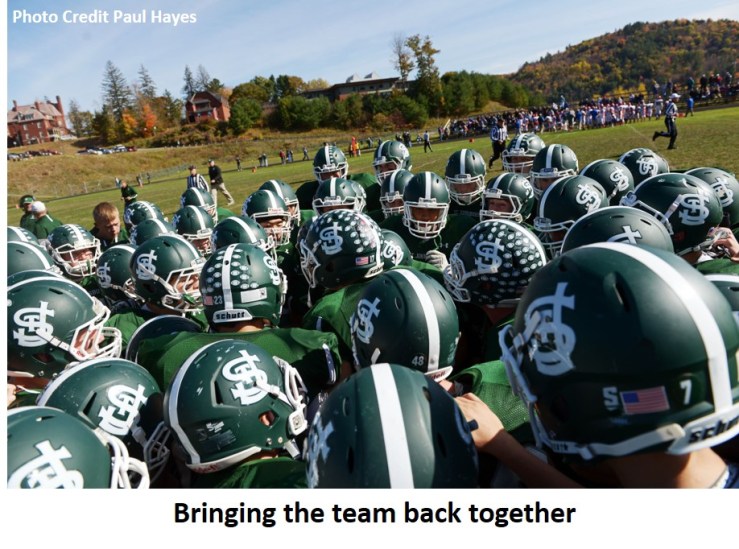
The uniform remains the same but the loss of the previous year’s seniors and the addition of incoming players challenge coaches at the start of every football season by bringing together a new team and dealing with new team dynamics. Following Tuckman’s stages of team development is always an interesting process as we go through the start of every season. While some aspects may have ebbed and flowed throughout Winter Drills, Spring Practice, and our Summer OTAs, Forming, Storming, Norming, and Performing must commence and phases must transition in relatively short order to be prepared for our opening kickoff.
On days 1-3 (Monday-Wednesday of this week), we go through the initial Forming stage where new members are introduced and they start to understand the team goals and their roles within the team. This stage is filled with a high level of uncertainty for most team members. Not just the new ones. Coaches are typically very directive as the basics are explained and the foundations of our culture are clarified and confirmed.
Days 4-6 bring the Storming stage which is characterized by conflict and competition. This is when we put on full pads and begin to compete in competitive drills culminating week 1 with an intrasquad scrimmage. It is a challenging phase where differences between players may arise vocally and even physically, but working out of these differences is crucial for team growth. Coaches reinforce expectations of performance, character, and culture.
Week 2 brings the Norming stage where conflicts are resolved and a cohesive working environment really starts to gel. Players develop a mutual respect for each other, begin to really understand interdependence, and work collaboratively to establish team norms and how they will complement one another to function effectively as a team. Coaches work hard to positively reinforce these traits and characteristics.
Week 3 is Game Week and brings the focus necessary for the Performing stage. At this point the team must be fully functional, collectively grasping goals and objectives, as well as working diligently and efficiently towards collective achievement. There is a strong sense of unity and focus on performance. Individual aspirations take a back seat to team priorities and culture. Further, the team is well-organized and is ready for the complex tasks and challenges it will face on the field against a thinking and performing opponent in Game 1.
Understanding these stages helps teams and coaches navigate the team development process to maximize their performance over time. Through nearly four dozen iterations as both a player and coach, Tuckman’s Teambuilding Phases ring true and remind us of the growth and maturation coaches must lead, guide, and direct each year.
Coach Rich Alercio is available to discuss coaching philosophy, X’s & O’s, or teach his O-Line “techniques in the trenches.” Contact Coach at richalercio@gmail.com and share http://www.olineskills.com with your colleagues and friends. Thanks for supporting this blog and joining our conversations, and as always, thanks for your time!
 O Line Skills