Culture Trumps Everything

In the top right-hand corner of the whiteboard in my office are the words “Culture Trumps Everything.”  It is a daily reminder of the importance of the people in the program over all else.  Below I share a recent email from a longtime coach:.  

I get asked fairly regularly why this program, or that program, is so much better than others that have the same number of kids or even may have fewer kids.  Inevitably my answer is usually coaching, their feeder programs, and the support from the AD/Admin or the community.  There are exceptions to that rule but good coaching matters.  Reminds me of the plaque we had to memorize when I was a player at Mass Maritime quoting Joe Kennedy Sr.

I’d say the same of football coaches

In his book Principles,” Ray Dalio, Chief Investment Officer of the world’s largest hedge fund, states, “The WHO is more important than the WHAT.  Focus on being the best person you can be, and surround yourself with like-minded people. That is a formula for success.”

Jim Collins in, “Good to Great,” when analyzing some of the world’s best-performing companies emphasizes “…get the right people on the bus…”

Each of these examples is about “The Team,” and teammates’ and coaches’ commitment to shared values, shared purpose, and shared vision. I find it comforting to see these commonalities across a variety of teams even though they’re focused on widely varying endeavors.

Circling back to football (and tangentially to “the finest ships afloat”), this Friday night Sept 29th, Alumni teammates from seven different decades will gather in Annapolis, MD to see Navy’s Sprint Football Team take on Mansfield University. (Sprint Football is full-contact varsity football only with a weight limit). When I think about the commonalities of culture and culture’s importance in underpinning success, it’s not surprising to see so many former players who collectively represent so many victories on the playing field, the battlefield, and in life, return to the cradle of their culture and celebrate its legacy.

What kind of culture do you cultivate?

Coach Rich Alercio is available to discuss coaching philosophy, X’s & O’s, or teach his O-Line “techniques in the trenches.” Contact Coach at richalercio@gmail.com and share http://www.olineskills.com with your colleagues and friends. Thanks for supporting this blog and joining our conversations, and as always, thanks for your time!  

Silver Linings

The weather wreaked havoc with Vermont high school football’s week #2, and the shortage of officials made the situation even more challenging.  

Vermont Teams had three games cut short and not rescheduled.  One of them was declared a tie.  Another game took three days to complete.  It was scheduled for Friday, rescheduled for Saturday, then again on Sunday.  Our team made the 2-hour drive across the state to Colchester and our only time on the field was for pregame warm-up.  Lightning struck just as captains were lining up for the coin toss.  We spent 2 hours in their gym as kickoff was pushed back 30 minutes with every strike of lightning.  One might think this situation would be disappointing, aggravating, or frustrating, but our team’s reaction was just the opposite.  Our players asked if they could bring in a Bluetooth speaker and get the bag of footballs so that they could play music and toss the ball around for as long as it took to resolve.  It became an opportunity for our team to bond, to have fun together, and to just play as friends.  

As lightning continued and 9pm approached, both schools agreed to postpone the game until Sunday at 11am.  Saturday was not an option as we could not secure officials.  Our team remained spirited for the 2-hour return home then showed back up early Sunday morning for Round 2 with the same enthusiasm.  At a time when people traditionally gather for church services, we were taking the field to play a football game.  I was initially concerned with how the long weekend of travel coupled with the early Sunday morning would impact our performance, but my concerns were eased quickly.  This past Friday night’s storm brought us a silver lining: our time bonding and playing together paid off with a cohesive and impressive road win over a good team.  One of the benefits of mutual struggle is that it brings people together.  Sharing privation and being thrown into a difficult situation with others facilitates the bonding process.

Coach Rich Alercio is available to discuss coaching philosophy, X’s & O’s, or teach his O-Line “techniques in the trenches.” Contact Coach at richalercio@gmail.com and share http://www.olineskills.com with your colleagues and friends. Thanks for supporting this blog and joining our conversations, and as always, thanks for your time!


Discipline & Attention to Detail

Two mottos I have tried to live my life by are “no job is too big or too small” and “leave things better than you found them.”  Both of those were exemplified by a fellow coach after our home opener last year.  After a Week #2 win over Middlebury High School, I walked through both locker rooms to see everyone was cleared out before heading home.  There was one person left in our visitor’s locker room, the Middlebury head coach, with broom in hand, he was sweeping the locker room floor.  We have always tidied up before departing the visiting locker rooms but have never taken it to that level.  

Recently, I started reading the book Legacy and discovered the inspiration for sweeping the locker room.  The book is the story of the New Zealand rugby team the “All Blacks,” a team with three Rugby World Cup victories and one of the most successful teams in match play. I’m amazed by the simplicity of some of their traditions, and the lessons they impart.  After games, their senior leaders pick up a long-handled broom and sweep their shed.  They make sure to do it properly so that no one else has to.  Both personal example, and attention to detail matter. The “All Black,” leaders both believe and demonstrate that if they have personal discipline in their lives, they are going to be more disciplined on the field. In a world of highly paid (and often pampered) professional athletes, no job is too small, and no detail goes unnoticed.

So this weekend as the Rugby World Cup kicks off in France, and we have our first road game of the season,  I will have to add a long-handled broom to our travel checklist so that we can leave Colchester even better than we found it. 

Coach Rich Alercio is available to discuss coaching philosophy, X’s & O’s, or teach his O-Line “techniques in the trenches.” Contact Coach at richalercio@gmail.com and share http://www.olineskills.com with your colleagues and friends. Thanks for supporting this blog and joining our conversations, and as always, thanks for your time!
Play for 11

Hours, days, weeks, and months of preparation culminate tonight as we turn the page from pre-season, to begin a new chapter: “In Season.” The Vermont high school football season kicks off tonight at 6:00PM on the campus of St. Johnsbury Academy as we welcome our rivals from down Interstate 91 the Hartford Hurricanes.

While today is but another day on the calendar, it’s one we’ve all waited for with anticipation. Coaches, players, parents, faculty, and staff alike have sacrificed their time, talents, and treasure to help our team prepare for tonight’s game and the start of this year’s season. Individual and collective skills… lessons in character… teambuilding… efforts to foster a culture of interdependence, and a belief in something bigger than ourselves…

Tonight we step on the field with a common vision of who we are and want to become. Common values: a belief in each other, and a belief in our team. A shared sense of purpose, and a belief in what we together, can achieve.

On our locker room board, we have a sign with our motto… “Play For 11.”  It is a daily reminder for our players to play for the 11 on the field and never for themselves.  To practice every day to be one of the 11 on the offense, defense, or any special team depth chart. To play for the 11 letters in St Johnsbury, our town.  To play for the 11 letters in Hilltoppers, our team name.  To play for 11 games which would have us in the championship game.  And to play for 11 wins making us undefeated state champions.  

Tonight marks an important step on our journey; a journey not to be taken lightly, and one best taken together. “Play for 11.”

Coach Rich Alercio is available to discuss coaching philosophy, X’s & O’s, or teach his O-Line “techniques in the trenches.” Contact Coach at richalercio@gmail.com and share http://www.olineskills.com with your colleagues and friends. Thanks for supporting this blog and joining our conversations, and as always, thanks for your time!
The First Follower

Coaches always stress the importance of leadership and the development of team leaders.  I tend to follow a definition stating, “Leadership is the sum of those qualities of intellect, character, and interpersonal skills enabling an individual to guide a group of people to successfully achieve a goal.” It is inarguable that strong leadership is critical to the success of any team, and personal example is one of the strongest attributes of a good leader. 

At the same time, it is also critical to develop followers.  Followers, especially the first follower, reinforce the leader’s example, and by doing so, set an example of their own.  Like the leader, he or she will stand out and is vulnerable to questioning and perhaps even ridicule by the group.  The first follower transforms the leader’s lone idea into a group’s thought, and at the same time makes it acceptable for others to join and follow as well.  The first follower is key in starting any movement, changing, or reinforcing any culture.  

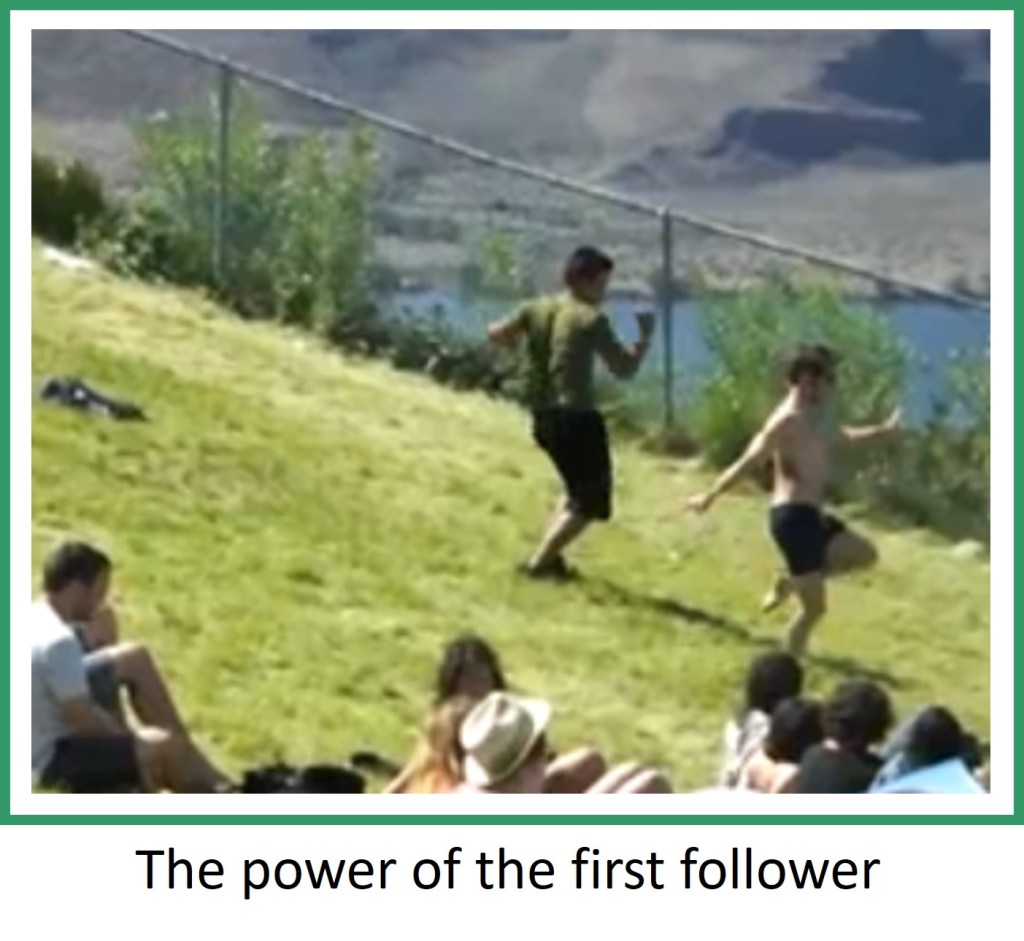
The picture here includes a link to Derek Sivers’ video and discussion of the first follower’s power.  In it, you will see a lone dancer in a field at a music festival who appears to be ostracized or at least segregated from those around him.  When one person shows the courage to join him, it opens the door for others to follow.  The first follower emulates the leader and makes the leader’s actions acceptable to others, and in turn, creates a movement.  At the same time, take note of the leader’s response to the first follower; he welcomes him and makes it about “them” rather than about him.  In doing so, he demonstrates the importance of the team, builds trust, and together the leader and first follower create an atmosphere many others find inviting. The first follower is an often underappreciated form of leadership.  

Coach Rich Alercio is available to discuss coaching philosophy, X’s & O’s, or teach his O-Line “techniques in the trenches.” Contact Coach at richalercio@gmail.com and share http://www.olineskills.com with your colleagues and friends. Thanks for supporting this blog and joining our conversations, and as always, thanks for your time!
Team Building & Interdependence

During the weeks of training camp, coaches teach players the plays, schemes, and techniques they need to know in order to have success during the season.  But, more importantly, coaches are developing a team that will work together to accomplish the mission.  

During the year I was born, 1965, psychologist Bruce Tuckman came up with the development sequence that describes the path a team follows on their way to high performance.  He labeled the four stages of team development: forming, storming, norming, and performing.

The “forming” stage is the beginning when a new team is formed.  Individuals will be unsure of the team’s purpose, how they fit in, and whether they will work well with one another.  Players will be anxious, curious, and excited to get going during this stage.  They will be looking to the team leaders for direction, and coaches need to be clear, concise, and candid in their directions and expectations.

Next comes the “storming” stage when conflict or friction can arise between team members competing for positions on the depth chart or with team leaders as they challenge their authority.  Left unchecked, this can lead to confrontations and simmering tensions.  This stage can make or break a team. Again, as coaches, we are responsible for reinforcing expectations and aligning behaviors toward the culture we want to create.

When properly guided through the storming stage, the team moves into the “norming” stage.  People start to resolve their differences, appreciate one another’s strengths, have more respect for team leaders, and begin to work together with a shared commitment to the team’s goals. The elements of culture we’ve been working on all spring and through summer OTAs are becoming natural and common. 

When teammates develop a common purpose, common vision, common values, and common goals, we enter the “performing” stage where differences among members are valued and used to enhance team performance to work at its full potential. We’ve grown to become interdependent, value each other’s contributions, and demonstrate proficiency at the scale of the team. As Coaches, we look to reinforce the very best aspects of teamwork, camaraderie, character, and culture.

As stated in previous blogs, we do not end our last practice of each day with a demoralizing conditioning drill that has little translation to increased athletic and team performance.  Rather, we play full-speed team-building games requiring athletes to work together, use strategy, and make good decisions while they are running, changing direction, accelerating, and decelerating.  They are working through Tuckman’s phases, getting conditioned, and increasing athletic performance without even knowing it.  They think they are just playing and having fun.  As playing football should be.

Coach Rich Alercio is available to discuss coaching philosophy, X’s & O’s, or teach his O-Line “techniques in the trenches.” Contact Coach at richalercio@gmail.com and share http://www.olineskills.com with your colleagues and friends. Thanks for supporting this blog and joining our conversations, and as always, thanks for your time! 

A Little Encouragement Goes A Long Way

When you work any type of construction job and use a power tool with an extension cord, you learn to tie the two together so that they do not become disengaged.  If the tool is not connected to the power source it will not work, and the job cannot be accomplished.  

People are the same way.  They need to be connected or engaged in order to do the work and get the job done.  A Gallup Poll of employee engagement divided workers into three categories: engaged, disengaged, and actively disengaged.  Those who were engaged cited employee recognition as the number one driver of engagement.  It is the best way to make people feel valued and to motivate them to give their all.  And that recognition can come in a variety of ways.  I remember my first training camp as a college football player and running a play vs our starting defense.  It was a Swing Screen that had me pass set then sprint out down the line of scrimmage to lead for a delayed swing of the running back out of the backfield.  The Safety filling the alley never saw me coming and it was the type of block you usually only dream of.  As I excitedly returned to the huddle, I was met with a hug from our OLine Coach, a high-five from our Offensive Coordinator, and a stare coupled with nods of approval from our head coach.  

To be very candid, during that first week of 3-a-days, I was contemplating what I was doing there and questioning my ability to ever play college football.  I was low on the depth chart, recovering from a season-ending injury and three surgeries between high school and college. Quite candidly, given all I had endured, it was difficult seeing a path forward.   That Gallup Poll would have categorized me as disengaged.  Then that Swing Screen was called and those coaches gave me what I had longed for, recognition which led to a feeling of connectivity.  Four weeks later, I made my first college start.  Two years later, I was voted a team captain.  That play and those coaches’ reactions turned the tide of my college career.  

Some of you may recall the comedic commercials of “Terry Tate, Office Linebacker.” Thankfully we don’t see the kinds of hits I put on that safety unless it’s a spoof like Terry Tate, but we do see folks in all sorts of offices, worksites, or other scenarios doing their jobs every day. In some cases, though an otherwise mundane task, our recognition of their efforts has the potential to shift their mindset the way my coaches shifted mine. Thanking the cleaning crew for keeping the office neat and clean, thanking the lunch lady for serving with a smile, or anyone else doing a job well that might otherwise be taken for granted. Hugs, high fives, pats on the back, nods of approval, and words of affirmation can all be quick and easy ways to give employees or team members the recognition they need to feel engaged and get the job done.  

Coach Rich Alercio is available to discuss coaching philosophy, X’s & O’s, or teach his O-Line “techniques in the trenches.” Contact Coach at richalercio@gmail.com and share http://www.olineskills.com with your colleagues and friends. Thanks for supporting this blog and joining our conversations, and as always, thanks for your time! 
R&R, & Life Long Learning

With our 7v7 Tournament, Strongman Competition, and OLine Challenge behind us, we enter Vermont’s mandatory Dead Period prior to the start of Training Camp on Monday 14 August.  Although the colloquialism of “Dead Period,” is quite common, I’d rather refer to it as Rest and Recovery Period. For 35 years, I have always taken the last week or two before Training Camp to enjoy vacation time, travel, and visit family.  This year will be no different.  

While “recharging my batteries,” the other thing I typically do is read.  Generally speaking, I do not read for pleasure but rather for professional development.  Sometimes coaches who fall into the realm of “long-time veterans” feel they have all the requisite knowledge and need not read more on coaching.  I do not fall into that category and would like to think I’m a lifetime learner.

When I’m asked about suggested readings, I always offer “The Boys in the Boat,” by Daniel James Brown.  While it is not a football book, there is much to learn about the importance of teamwork, resilience, and coaching.  If the request is for a football book, I recommend Bill Walsh’s, “The Score Takes Care of Itself.”  

I recently had the pleasure of meeting and spending some time with Dr. John Alder, Head of Player Development for Welsh Rugby Union.  When I asked him for suggested readings he offered: “Tyranny of Talent,” by Joseph Baker, “The Coaches Guide to Teaching,” by Doug Lemov, and Sebastian Junger’s, “Tribe.”  I started reading “Tribe” this week.  In the top right-hand corner of the whiteboard in my office are written the words “Culture Trumps Everything.”  Junger’s book is teaching me why that is more important than ever.  And so I’ll rest, recover, read, and learn in order to be best prepared to begin the 2023 season. When staff and players return at the end of these two short weeks, culture will underpin everything we do.

Coach Rich Alercio is available to discuss coaching philosophy, X’s & O’s, or teach his O-Line “techniques in the trenches.” Contact Coach at richalercio@gmail.com and share http://www.olineskills.com with your colleagues and friends. Thanks for supporting this blog and joining our conversations, and as always, thanks for your time! 

NEK 7v7, Strongman Competition, & OLine Challenge

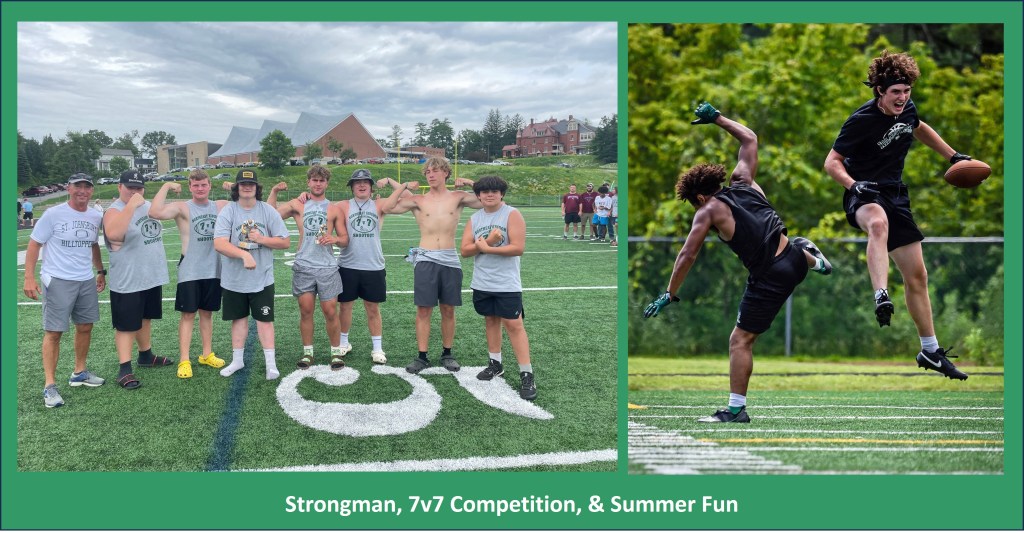
On Saturday 29 July we will host our annual Northeast Kingdom 7v7 tournament.  What I believe makes our tournament special is that we also host a Strongman competition and O-Line Challenge so that the linemen get to compete as well.  

While the 7v7 teams play games in our turf stadium, the Offensive Linemen will compete on our grass field in four individual events in the strongman and 5 team events in the challenge.  For the strongman, linemen are divided into two groups by weight; over 220lbs and under 220lbs, to compete in the following events: Log Press, Farmers Carry, Hexbar Deadlift, and Seated Sled Pull.  

After the completion of the Strongman, teams of 5 will compete in the O-Line challenge in the following events:  Sled Drive Relay, Tire Flip Relay, Sandbag Carry Relay, Slam Ball Thruster Toss, and Tug-of-War.  

In between games, I always go over to watch the competition and am always amazed at what I witness.  Athletes from competing schools cheering for each other to both encourage and reward great effort while rivals become friends.  

Event Chart Follows:

Strongman
EventScoring>220#<220#Distance
Log PressMax Reps in 1minLog (85#)Log+5s+2.5s (100#) 
Farmers CarryBest TimeBar+10s+5s (90#)Bar+25s (110#)30yds
Hex Bar DeadliftMax Reps in 1min215#255# 
Seated Sled PullBest Time80#105# 
     
O-Line Challenge    
EventScoringDistance/WeightDescription 
Slam Ball Thruster TossTotal Distance of 5 tosses30# slamballNext person picks up slam ball from location that last person threw it 
Sled Drive RelayBest Time30 yds per personGo 30 yds, turn it around, next person goes 30 yds 
Tire Flip RelayBest Time30 yds per personGo 30 yds, turn it around, next person goes 30 yds 
Sandbag RelayBest Time30 yds per person, 80# bagGo 30 yds, drop it, next person picks it up & goes 30 yds 
Team Tug-of-WarSeeded Single Elimination   

Coach Rich Alercio is available to discuss coaching philosophy, X’s & O’s, or teach his O-Line “techniques in the trenches.” Contact Coach at richalercio@gmail.com and share http://www.olineskills.com with your colleagues and friends. Thanks for supporting this blog and joining our conversations, and as always, thanks for your time! 

Prioritize & Execute

We begin our weeklong Mini Camp next week.  As we finalize our installs, practice schedules, and scripts, I am reminded of past Mini Camp blogs.  I often reference preparing for Mini Camp as you would a vacation…  “You cannot fit all of the clothes into one suitcase.” 

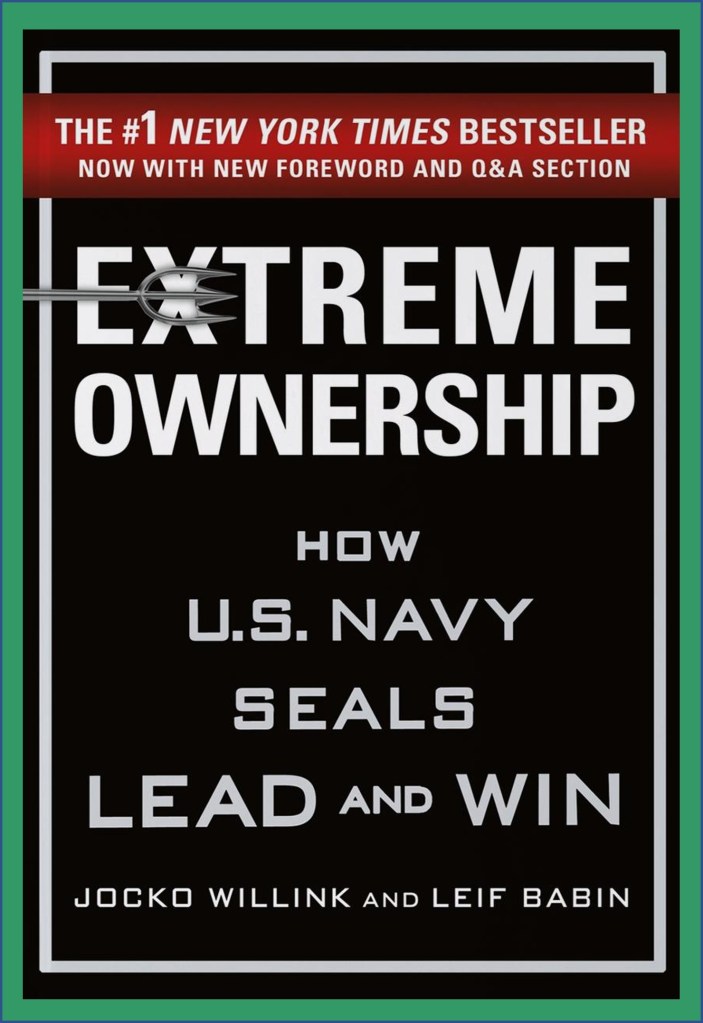
The process of deciding what goes in, whether clothes into your suitcase or plays into your plan, can be overwhelming.  There are so many things to choose from.  You need to prioritize.  In Jocko Willink and Lief Babin’s book Extreme Ownership, Jocko dedicates a chapter to “Prioritize and Execute.”  Applying Jocko’s philosophy in a football context, he suggests the following steps to effectively prioritize and execute:  First, determine which play is the highest priority.  Next, explain the play to your team in the simplest way possible (so there is no room for misunderstanding.)  Next, figure out a solution to any perceived problems such as a defensive front or coverage that may cause an issue.  Then solicit input from coaches and team leaders on a solution.  Once that top priority is addressed and we have a consensus, focus on the next highest priority, and repeat the process.  

The parameters of teaching in a way everyone can understand and having solutions to any problems that can arise, inherently limits the volume we can teach.  We will limit ourselves to one play per day for Run and Pass.  At the end of the week, we hope to have effectively installed 5 running plays and 5 passing/screen plays that our players can execute vs any front or coverage.

Priorities matter on the field, and in life. Six and a half years ago I made it a priority to spend time collecting and sharing my thoughts here on Olineskills.com. I had no idea how they would be accepted or how long we would run. Today marks the 300th time we’ve published a blog and I’ve been overwhelmed by the positive response from players, coaches, parents, faculty, and community members. I can’t thank you enough. We’ve created a community sharing ideas, goals, and objectives, and it’s my most sincere hope that we’ve done so in the spirit of those who invested in us. It’s my privilege to be a coach. It’s my privilege to honor the examples of so many who led, guided, and directed us, and those who lead, guide, and direct tomorrow’s leaders. It’s also my privilege to share a few thoughts with so many of you each week. Thank you!

Coach Rich Alercio is available to discuss coaching philosophy, X’s & O’s, or teach his O-Line “techniques in the trenches.” Contact Coach at richalercio@gmail.com and share http://www.olineskills.com with your colleagues and friends. Thanks for supporting this blog and joining our conversations, and as always, thanks for your time!