To Stay in Your Lane… (or not?)

Crawling through bumper-to-bumper traffic on I-10 last week, I found myself reflecting on that familiar phrase: “Stay in your lane.” It’s advice we’ve all heard—stick to what you know, don’t overstep boundaries, don’t meddle in matters beyond your expertise.

Earlier this spring, crossing the George Washington Bridge en route to our O-Line Clinic, I witnessed the aftermath of a multi-car accident that had traffic backed up for miles. One driver’s decision to veer from their lane had cascading consequences for hundreds.

In athletics, we operate on a four-lane highway: Players, Coaches, Parents/Fans, and Officials. When everyone maintains their appropriate role, the program advances smoothly. When boundaries blur, collisions occur. At higher levels of the game, a fifth lane emerges: Agents.

This delicate balance between roles came to mind while listening to NFL draft coverage. Take Deion Sanders—an NFL legend, successful coach, and by all accounts, a devoted father. When he stepped partially into that agent lane while advocating for his son during the draft process, it raised questions about whether crossing boundaries helped or hindered his son’s prospects.

The challenging reality is that growth happens at boundaries. Educational theorists call this the “zone of proximal development”—that space just beyond our comfort zone where real progress occurs. Jeff Bezos frames decision-making in terms of “one-way doors” versus “two-way doors.” Two-way doors allow us to return if our risk doesn’t pay off; one-way doors represent irreversible decisions requiring greater caution.

So when should we venture beyond our lane? Consider these questions:
• Is this a two-way door that allows for recovery if things go wrong?
• Do I bring legitimate value to this new territory?
• Have I consulted those who will be affected by my lane change?

Football teaches us that disciplined execution within assigned roles creates team success, but it also rewards calculated risk-taking at the right moment. The most memorable plays often come when someone recognizes the perfect moment to break pattern… not recklessly, but with purpose.

Sometimes greatness requires changing lanes. Other times, staying put demonstrates wisdom. The difference lies not in the action itself, but in the judgment behind it.

Coach Rich Alercio is available to discuss coaching philosophy, X’s & O’s, or teach his O-Line “techniques in the trenches.” Contact Coach at richalercio@gmail.com and share http://www.olineskills.com with your colleagues and friends. Thanks for supporting this blog and joining our conversations, and as always, thanks for your time!

Rites of Spring

For millennia, humans have celebrated rites of spring, embracing renewal and refreshment as we shake off the darkness and cold of winter. Longer days bring spring flowers, animal migrations, and budding trees, reminding us of the promise of new beginnings. Easter symbolizes hope and joy for Christians, offering permission to leave the past behind and embrace a new life. Easter eggs and the Easter bunny represent renewal and rebirth, themes that resonate deeply during this season of change.

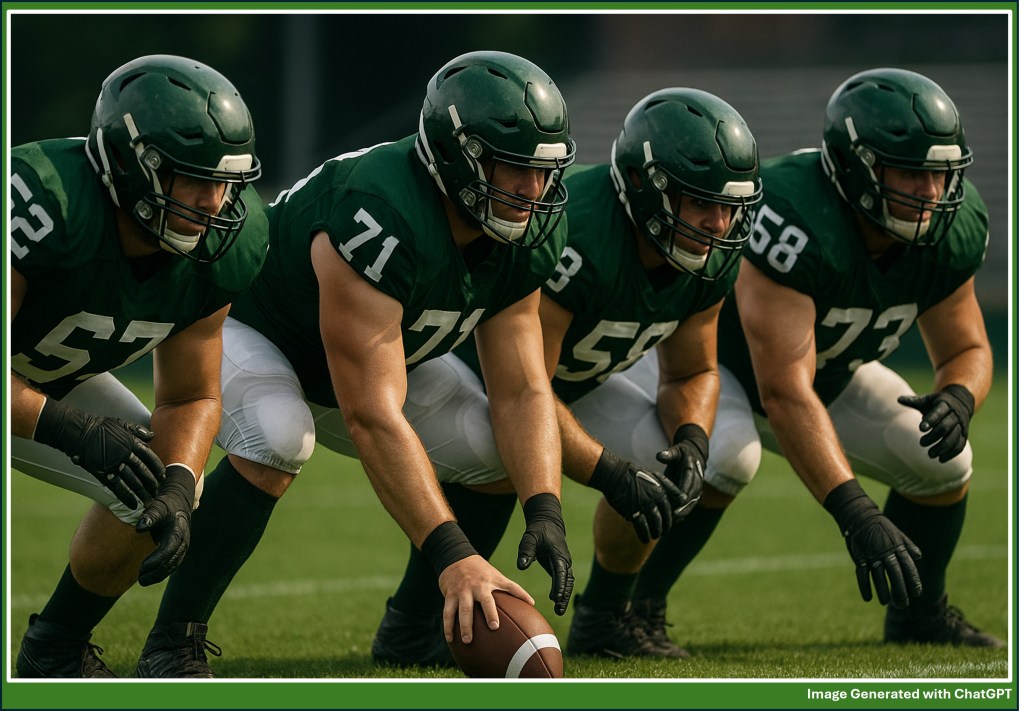
Spring also marks a time of transition for football teams. Seniors prepare for graduation and the next chapter of their lives, while coaches focus on the players who will fill the depth chart for the upcoming season. Each new football season offers a clean slate—a chance for teams and players to compete, grow, and achieve new goals.

The NFL Draft, held every April, epitomizes this sense of renewal. Teams seize the opportunity to acquire fresh talent, fill roster gaps, and rebuild for the future. The timing of the draft, coinciding with Easter, underscores the shared themes of new beginnings and fresh starts.

Inspired by this annual ritual, our coaching staff conducts its own draft exercise. After celebrating Easter with their families and enjoying the NFL Draft, each coach receives an alphabetical list of all eligible returning players. They channel their inner Mel Kiper or Todd McShay, ranking players in order of their “Best Available Player.” No criteria are provided—each coach uses their own parameters to create their list.

I then compare their lists to mine and to each other’s, identifying our team’s “Best 11.” This process helps shape personnel packages, position changes, and highlights outliers. When a coach ranks a player significantly higher or lower than the staff average, it sparks valuable conversations to understand differing perspectives. This collaborative exercise ensures alignment as we prepare for Other Team Activities (OTAs) in June, setting the stage for a season of growth and success.

Coach Rich Alercio is available to discuss coaching philosophy, X’s & O’s, or teach his O-Line “techniques in the trenches.” Contact Coach at richalercio@gmail.com and share http://www.olineskills.com with your colleagues and friends. Thanks for supporting this blog and joining our conversations, and as always, thanks for your time!
Hard Work in the Trenches: Building Skills and Bonds at the Alercio OLine Clinic

To borrow a line from famed Notre Dame sports writer Grantland Rice, outlined against a blue, gray April sky the Alercio OLine Clinic rode again at the Hun School of Princeton this past Sunday. The historic campus provided the perfect backdrop for our tradition of offensive line development excellence.

Players rotated through specialized stations focusing on fundamental skills: proper stance and first-step explosion, hand placement techniques for both blocking scenarios, and communication protocols for various defensive fronts. The progress from morning to afternoon was remarkable, with many young men showing dramatic improvement in their technique and understanding of leverage points.

As stated in last week’s blog, the clinic also provided an opportunity for players to connect with teammates and build relationships. I watched with pride as veterans took underclassmen under their wing, demonstrating drills and offering encouragement. During breaks, camaraderie was palpable as stories were shared across school boundaries—rivals on Friday nights becoming colleagues in the craft of line play.

Another benefit was exposure to different coaching styles and philosophies, expanding players’ understanding of their unique position in football. Our diverse coaching staff brought multiple perspectives on technique and mindset.

Participants should build upon this experience by continuing to gather throughout Spring and Summer. Remember, championships aren’t won on Friday nights in the fall—they’re earned through the invisible work put in during these crucial development months.

Our next clinic is on Sunday, May 25th at West Orange High School in New Jersey. Bring your hard hat and lunch pail attitude—we’ll provide the knowledge and skills to help you dominate the line of scrimmage this fall.

Coach Rich Alercio is available to discuss coaching philosophy, X’s & O’s, or teach his O-Line “techniques in the trenches.” Contact Coach at richalercio@gmail.com and share http://www.olineskills.com with your colleagues and friends. Thanks for supporting this blog and joining our conversations, and as always, thanks for your time!
Surprisingly More Than Techniques In The Trenches

One could cite many benefits of attending the Alercio Oline Clinics. Throughout the Mid-Atlantic states and spanning far up into New England, Coaches and athletes learn “Techniques in the trenches,” like the stance, steps, visual targets, and strike points. Many might not expect a class on Physics, but we dive in on transfer or force and rate of force development, and momentum as an offensive lineman.

While our program, teaching points, drills, and memory aides all leave lasting impressions, over the last 25 years coaches have relayed the greatest value of attending Alercio OLine Clinics, is the shared experience or waking up early on a Sunday four months before the football season, loading into a vehicle with teammates, taking a road trip, stopping for something along the way, going through 4 hours of training, then taking the return trip home.

As coaches, we hope to create a shared sense of purpose, shared values, shared goals, and a shared hope for what we, as a team, can become…

These shared experiences deepen connections among team members, fostering camaraderie and mutual understanding. Spending extended time together in close quarters breaks down barriers and encourages open communication, and breeds interdependence, all mission-essential skills on the offensive line. Lastly, a change of scenery can reinvigorate a team’s energy.

Take the time to build your team’s interdependence and join us this Sunday at The Hun School of Princeton. Get your brochure here or register using the QR code below.

Coach Rich Alercio is available to discuss coaching philosophy, X’s & O’s, or teach his O-Line “techniques in the trenches.” Contact Coach at richalercio@gmail.com and share http://www.olineskills.com with your colleagues and friends. Thanks for supporting this blog and joining our conversations, and as always, thanks for your time!
A Path to Success

It is not what the coach knows, or even what he said…It is what the players learn.

A coach can have all the strategies and techniques in the world, but if the players don’t truly learn, internalize, and apply them on the field, the coach’s knowledge will not translate to success. How well the players absorb, understand, and apply what is taught is what truly matters. Coaches must be teachers and educate their players. Education is the transfer of knowledge from the teacher to the student, or in this case, the coach to the player. Different athletes have different learning styles. Virtually all require some type of reinforcement, as concepts, tactics, techniques, and procedures are perishable over time.

Having a teaching or coaching manual is crucial for structure, consistency, and long-term success in coaching football. A manual ensures every player and coach in the program follows the same techniques, maintaining a uniform approach to playing style and player development. It provides a roadmap for player progression from fundamentals to advanced tactics. Further, it enables concepts to scale, and staff members and returning players are able to assist new team members. Lastly, it provides continuity over time as new players join the team, preventing disruptions and ensuring a smooth transition from year to year.

From stance and steps to run, pass, and screen techniques, to run blocking and pass protection schemes, the Alercio OLine Manual provides you, your staff, and your players with a roadmap for success. They sell for $20, which includes shipping, and helps me cover the costs of editing and production. As a bonus, manuals are available at any of the Alercio OLine Clinics for only $10. To order yours, contact email me at richalercio@gmail.com.

Coach Rich Alercio is available to discuss coaching philosophy, X’s & O’s, or teach his O-Line “techniques in the trenches.” Contact Coach at richalercio@gmail.com and share http://www.olineskills.com with your colleagues and friends. Thanks for supporting this blog and joining our conversations, and as always, thanks for your time!
Dig Your Well Before You’re Thirsty

“Dig your well before you’re thirsty,” is a metaphor for preparing in advance for times of need or difficulty. Productivity and sales author Harvey McKay wrote a book of the same title in 1999, and the adage is apropos today as it was over a quarter century ago. It reminds us to prepare for future needs in advance rather than waiting until it is too late. The ancient version of the proverb is attributed to Chinese philosopher Zhu Xi, and it is a common saying across various cultures, including a Japanese proverb that says, “When you feel thirsty, it is too late to start thinking about digging a well.” Even the earliest recorded stories from Genesis teach the idea of preparation and work today, as a worthy sacrifice for the benefits of tomorrow. Regardless of source, the core message is proactively addressing potential problems before they become critical.

I was recently contacted by two different high school coaches. One was inquiring about bringing the offensive linemen from his youth program to one of my OLine Clinics to develop for their future. The other was asking if I knew of any OLine Coaches looking for a job since he has no one on his staff with OLine experience. These are coaches who are digging their well before they are thirsty and are great examples of proactively addressing a potential problem before it is a crisis.

Whether in networking, relationship building, or skill development, we can help coaches and players “dig their wells before they are thirsty,” at upcoming Alercio OLine Clinics. Join us this Spring as we work hard, sacrifice now, and prepare to reap the benefits this Fall, and for years to come!

Coach Rich Alercio is available to discuss coaching philosophy, X’s & O’s, or teach his O-Line “techniques in the trenches.” Contact Coach at richalercio@gmail.com and share http://www.olineskills.com with your colleagues and friends. Thanks for supporting this blog and joining our conversations, and as always, thanks for your time!

Spring Games

We ended our Spring practices with a Spring game. No not in pads on a field. Our field is still covered in snow. We broke the players up into 3 teams and played a round-robin of Ultimate Football. It is Ultimate Frisbee but with a football. The competition borders somewhere between structured and unstructured. We give some base rules then just let the teammates play and have fun while our coaching staff observes.
Though largely unstructured, there is a “method to our (seeming) madness.” As coaches, we evaluate gross motor skills (running, jumping, throwing, catching, covering) by observing how they move their bodies in active play. We also evaluate how they respond emotionally to competition. Do they get frustrated or stay positive and encouraging when things go wrong? Our veterans have been taught to be “thoughtfully responsive, not emotionally reactive…” Will they remember? Will they share the lesson with a rookie?

Lastly, and perhaps most importantly, we observe how they interact with each other as social hierarchies quickly form within the team. Most players fall into one of three categories: competitive, cooperative or solitary. The rare player(s) who can be both competitive and cooperative while maintaining emotional regulations (thoughtfully responsive) are those likely to emerge as team leaders.

As coaches, we gather a great deal of information about the players and look forward to lively discussions at upcoming staff meetings. As players, they are just playing and having fun.

Coach Rich Alercio is available to discuss coaching philosophy, X’s & O’s, or teach his O-Line “techniques in the trenches.” Contact Coach at richalercio@gmail.com and share http://www.olineskills.com with your colleagues and friends. Thanks for supporting this blog and joining our conversations, and as always, thanks for your time!

Spring Combine

Spring football practices wrap up this week and we will conclude the sessions with a combine test. Similar to the NFL combine which was recently held in Indianapolis, we test our players in a variety of events to gather measurable results. We test the 40 yard dash for speed, the “L drill” for agility, shuttle for quickness, broad jump for lower body explosivity, Medball toss for whole body explosivity, bench press max reps for upper body muscular strength and endurance, goblet squat for lower body muscular strength and endurance along with core stabilization, and pullups for overall fitness. Athletes’ by event results are organized on a spreadsheet that calculates a score for each event of 0-20 points, and then an overall score for each player.

While the NFL combine has been jokingly nicknamed the “underwear olympics” because it just showcases the physical attributes of the athlete and not the immeasurables that are so important in football. But we, like the NFL, have found that there is a strong correlation between combine results and on field performance. With many athletes competing over many years, I can confidently say, our best players are most often those who score the highest.

The other reason for the testing is to see our players compete against themselves and others. There is an old saying, “competition makes a horse run.” That holds true for athletes as well. Players will work to beat their own scores from Training Camp as well as the scores of their teammates during the event. Amongst teammates, one would expect fierce competition at the top of the leaderboard, but it’s often interesting to see some of the fiercest competition coming from those striving not to be on the bottom. We will share the results with every player so that they can see where they compare with their teammates before heading into our Spring lifting sessions and Summer OTAs. Lastly, we trust that it serves as a baseline for comparison and motivating factor in our players’ off-season training. As Peter Drucker, a highly influential management consultant, educator, and author used to say, “What gets measured, gets managed.”

Coach Rich Alercio is available to discuss coaching philosophy, X’s & O’s, or teach his O-Line “techniques in the trenches.” Contact Coach at richalercio@gmail.com and share http://www.olineskills.com with your colleagues and friends. Thanks for supporting this blog and joining our conversations, and as always, thanks for your time!

Automaticity

Vermont High School football is allowed six Spring practices between the Winter and Spring sports seasons. We begin ours this week with a focus on reinforcing automaticity. Automaticity in sports refers to the ability of an athlete to perform skills or movements at a nearly instinctive level. It occurs when an action becomes ingrained through extensive practice and repetition, allowing athletes to execute complex tasks quickly and efficiently under pressure.

Driving, walking, and typing on a keyboard are everyday examples of automaticity. We perform these tasks seemingly without conscious thought, even though awareness of our environment is essential. Our goal is to create muscle memory through repeated practice, strengthening neural pathways and making complex movements more natural while requiring little cognitive effort. This instinctive ability leads athletes to react faster by avoiding pauses common to conscious decision-making and maintain consistency while adapting game conditions.

We’ve previously discussed Colonel John Boyd’s OODA loop (Observe, Orient, Decide, Act) and its relevance wherever time-critical decisions determine success. Automaticity enhances each phase of this loop: players with well-developed automaticity observe more efficiently by focusing on relevant cues, orient faster through pattern recognition, make decisions more confidently based on ingrained knowledge, and execute actions with greater precision. By developing automaticity in fundamental skills, our athletes free up mental bandwidth to handle the unpredictable aspects of football. The targeted skills we practice daily aren’t just about repetition—quality repetitions matter more than time spent practicing.

Coach Rich Alercio is available to discuss coaching philosophy, X’s & O’s, or teach his O-Line “techniques in the trenches.” Contact Coach at richalercio@gmail.com and share http://www.olineskills.com with your colleagues and friends. Thanks for supporting this blog and joining our conversations, and as always, thanks for your time!