Three Girls, One Camp, Infinite Possibilities

We recently hosted our annual Hilltopper Youth Football Camp. In looking through the camp photos, the one shared in this blog jumped out at me—not only because of the 6’3″, 220-pound 8th grader who has the athleticism to make this spectacular one-handed catch, but because of the girl in the foreground. She is one of three girls who attended our camp.

These brave young ladies participating in a traditionally male-dominated sport are breaking the cycle of gender norms and showing other kids that football truly is for everyone. Like boys have experienced for decades, girls who play football gain confidence, discipline, and a sense of belonging—qualities that can positively impact them for the rest of their lives.

With the backing of the NFL and Nike, flag football is growing rapidly and is now sanctioned as a varsity sport for girls in several states. Some NAIA schools are now offering college football scholarships to women for flag football. In 2028, women’s flag football will make its debut in the Olympics!

I have often said that girls are the future of football because girls who love the game will become mothers who encourage their kids to play football. But maybe they are not just the future of football. Maybe they are already part of the present.

These three young ladies at our camp reminded me that the game we love is evolving, and that evolution includes opening doors that have been closed for far too long. When we teach fundamentals, teamwork, and perseverance, those lessons are universal, regardless of gender. The field (like life) is big enough for everyone who wants to compete, learn, and grow through the game of football.

Coach Rich Alercio is available to discuss coaching philosophy, X’s & O’s, or teach his O-Line “techniques in the trenches.” Contact Coach at richalercio@gmail.com and share http://www.olineskills.com with your colleagues and friends. Thanks for supporting this blog and joining our conversations, and as always, thanks for your time!
A Path to Success

It is not what the coach knows, or even what he said…It is what the players learn.

A coach can have all the strategies and techniques in the world, but if the players don’t truly learn, internalize, and apply them on the field, the coach’s knowledge will not translate to success. How well the players absorb, understand, and apply what is taught is what truly matters. Coaches must be teachers and educate their players. Education is the transfer of knowledge from the teacher to the student, or in this case, the coach to the player. Different athletes have different learning styles. Virtually all require some type of reinforcement, as concepts, tactics, techniques, and procedures are perishable over time.

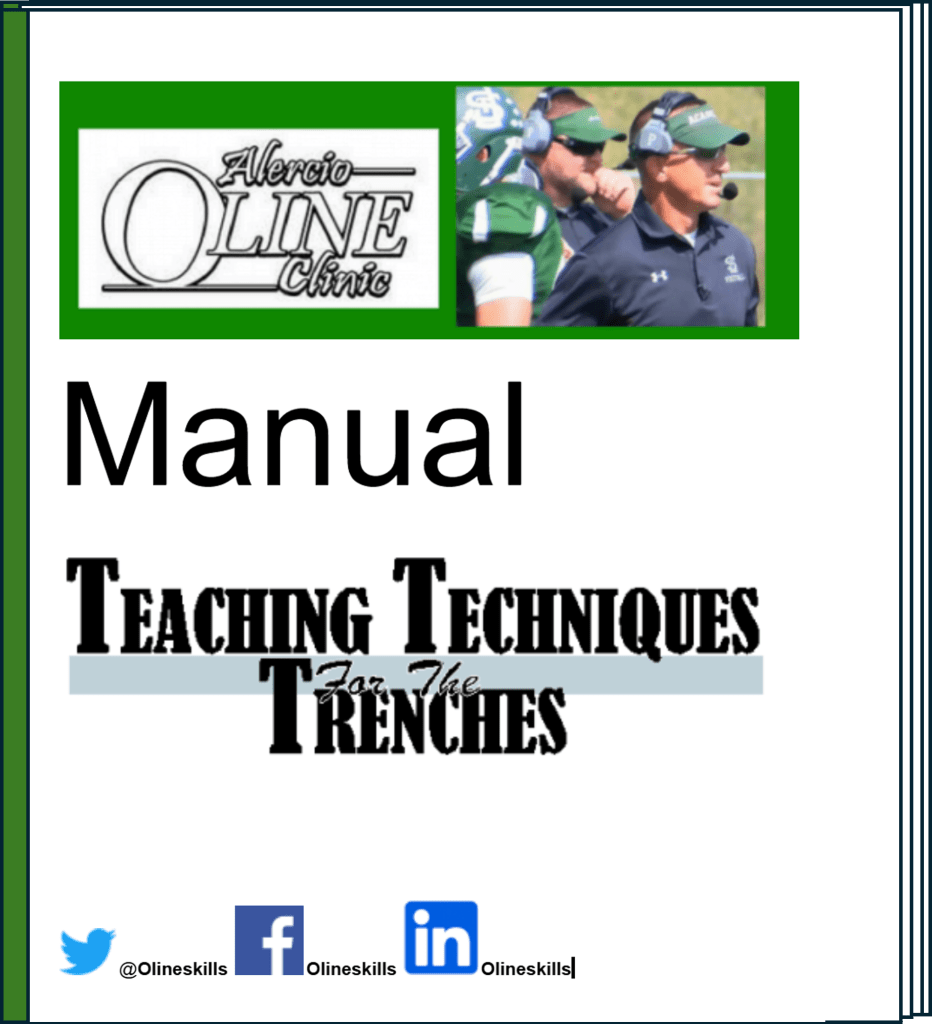
Having a teaching or coaching manual is crucial for structure, consistency, and long-term success in coaching football. A manual ensures every player and coach in the program follows the same techniques, maintaining a uniform approach to playing style and player development. It provides a roadmap for player progression from fundamentals to advanced tactics. Further, it enables concepts to scale, and staff members and returning players are able to assist new team members. Lastly, it provides continuity over time as new players join the team, preventing disruptions and ensuring a smooth transition from year to year.

From stance and steps to run, pass, and screen techniques, to run blocking and pass protection schemes, the Alercio OLine Manual provides you, your staff, and your players with a roadmap for success. They sell for $20, which includes shipping, and helps me cover the costs of editing and production. As a bonus, manuals are available at any of the Alercio OLine Clinics for only $10. To order yours, contact email me at richalercio@gmail.com.

Coach Rich Alercio is available to discuss coaching philosophy, X’s & O’s, or teach his O-Line “techniques in the trenches.” Contact Coach at richalercio@gmail.com and share http://www.olineskills.com with your colleagues and friends. Thanks for supporting this blog and joining our conversations, and as always, thanks for your time!

Forging The Future

After the season is over and all the equipment is collected, players schedule a one-on-one year-end meeting with me.  These meetings serve as an opportunity to reflect on the past season, assess their progress, set off-season goals, and discuss where they see themselves next year.

I try to orchestrate the process of self-reflection to be motivating and affirming.  I want players to recognize the progress they’ve made, the skills they developed, and the goals they reached.  Further, I try to very tangibly acknowledge the contributions they made to the team, fostering a sense of appreciation and making the player feel valued in the program.  It also provides an opportunity to discuss what didn’t go well and why.  I’m genuinely interested in players’ perceptions and encourage them to raise concerns, discuss obstacles they faced, and share challenges they have off of the field that impact their performance on the field.

These meetings also give me an opportunity to provide feedback on what they did well and opportunities for improvement.  I make every effort to ensure the feedback is clear, actionable, and focused on improvement for the individual player and the team.

The year-end meetings are a chance to strengthen the coach–player relationship by creating a two-way dialogue that hopefully fosters trust, leads to more engaged players, and conveys how much I care about them.  This opens the door to conversations about any misunderstandings that may have occurred during the season, while opening the door to future dialogues whenever players feel the need.

By giving players an opportunity to voice their opinions, share their concerns, and provide feedback we create players who feel more engaged and invested in the program leading to greater retention and hopefully recruitment of their classmates.  

In closing, year-end meetings are a critical opportunity to reflect, learn, plan, and motivate ensuring both the player and the team are set up for success and looking forward to the year ahead.  

Coach Rich Alercio is available to discuss coaching philosophy, X’s & O’s, or teach his O-Line “techniques in the trenches.” Contact Coach at richalercio@gmail.com and share http://www.olineskills.com with your colleagues and friends. Thanks for supporting this blog and joining our conversations, and as always, thanks for your time!  

Intrinsic vs Extrinsic Motivation

Earlier this week I received a call from a friend who stepped away from coaching after winning a couple of state championships but is now considering a return to the sidelines.  He had one question, “What’s the biggest difference between kids now and 5 years ago.”  Without hesitation, I replied. “extrinsic vs intrinsic motivation.”

My wife, a pediatric occupational therapist, working in 17 schools with over 150 kids in her caseload, would provide a laundry list of the issues kids struggle with post-COVID.  Many of them come into play when coaching today’s players and cause us coaches to alter teaching techniques, volume of material, and duration of meeting times.  But the biggest difference that impacts the entire team lies with the answer to his question.  

Before COVID, our players were intrinsically motivated. They engaged in all football related activities for the inherent satisfaction it provided.  They were motivated to be the best possible players and teams they could be on that day while doing that drill.  Year after year, players and teams worked hard to be as good or better than the previous year’s team and players perpetuating a culture of success.  They did not need external rewards or punishments to motivate them.  Today’s players seem to require more external motivation (rewards or punishments) to get the same level of performance we were accustomed to before COVID.  

Both types of motivation play important roles in driving behavior.  Understanding the balance and dynamics between intrinsic and extrinsic motivation is crucial for today’s coaches.  Both can be effective in encouraging desired behaviors, but intrinsic motivation is more sustainable and leads to greater personal satisfaction for individuals and collectively for the team.      

Coach Rich Alercio is available to discuss coaching philosophy, X’s & O’s, or teach his O-Line “techniques in the trenches.” Contact Coach at richalercio@gmail.com and share http://www.olineskills.com with your colleagues and friends. Thanks for supporting this blog and joining our conversations, and as always, thanks for your time!