Coaching is Coaching…

Coaching is Coaching

You’ve heard the saying before and it is true.  Coaching is coaching.  If you can coach, you can coach at any level.  I have had the good fortune of being invited to join training camp as a “visiting coach” with an NFL team when I was in between jobs, and I have had the pleasure of coaching my youngest son’s 5th & 6th grade flag football team.  I also coached my middle son’s padded flag team.  I have been an assistant, coordinator, and head coach at the high school level; and I have been a graduate assistant, assistant, coordinator, and head coach at the college level.  I have worked at both scholarship and non-scholarship schools.

I have worked with great coaches and below average coaches at every one of those levels.  Yes, there were a few coaches on that NFL team that were just off the charts in their ability to coach, but I worked with high school coaches who could have been very successful college coaches, and college coaches who could have been successful in the NFL.  The biggest difference I have found is in how much time you want or are able to commit.  As you know, the sun rises early and settles late during the summer months.  Every day of that NFL training camp, the staff reported before the sun came up and departed long after it had set.  We ate breakfast, lunch, and dinner in the training facility.  It was great as a visiting coach, but sure would be tough on a family.  The life of a college coach is extremely time consuming as well, even more so when you add recruiting across multiple states into the mix.

Over the past 30 years, I would say that I had the most fun back in 1991, as a part-time assistant at East Stroudsburg University while working 2 other jobs, living with 2 other coaches, barely able to pay the electric bill, but learning and coaching football every day.   But I have never been happier than I am now as an Assistant Athletic Director and Head Football Coach at St Johnsbury Academy in the Northeast Kingdom of Vermont coaching 2 of my 3 sons.  We all dream about coaching in the “big time” but make the big time where you are.

Over the next three weeks, I plan to share some thoughts about how I make my current role “the big time,” to me. I hope after 30 years of coaching I can share some of the lessons learned and help you avoid some of the obstacles I encountered along the way. I don’t presume to have all the answers, but just as my mentors shared their lessons with me and helped me grow as a coach, parent, and person, I’d like to reinforce their efforts and share some thoughts with you. Hopefully, together we can explore ways to maximize the best the coaching profession has to offer. I look forward to continuing the conversation.

Contact Coach Rich Alercio at richalercio@gmail.com
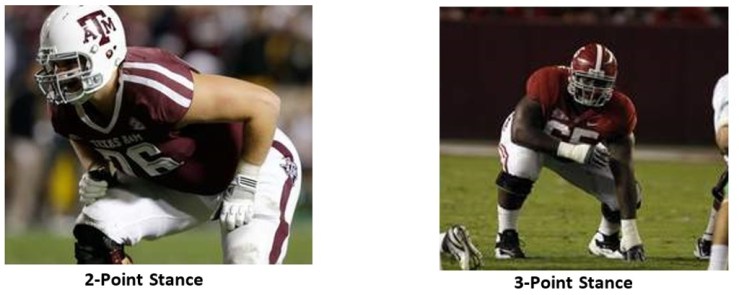
 

Offensive Line… 2 or 3 Point Stance?

2-point or 3-point?

2 and 3pt stance

In the spring of 2004, after hosting the 3rd annual Alercio OLine Clinic with over 700 players and coaches in attendance, I was contacted by K.C. Keeler, who at the time was the head football coach at the University of Delaware.  Coach Keeler and his offensive line coach, Kyle Flood, invited me down to Delaware to discuss what had made my clinics so popular.

The Blue Hens had just won the 2003 I-AA National Championship and both Coach Keeler and Coach Flood were well known in the northeast as offensive innovators.  I knew a trip to Newark would be a great opportunity for me to learn.  Having watched their national championship game on ESPN in December, I was struck by something almost unheard of 15 years ago.  They played the entire game with their offensive linemen in 2-point stances.

After sharing the details of my clinic with them, they made themselves and their video available to me.  I watched over and over as they successfully ran Power in short yardage and goal line situations with their linemen in 2-point stances.  I was sold.

The 2-point stance has allowed our players to look to the sideline for plays in our no-huddle system.  It makes it easier for them to recognize fronts and communicate blocking schemes.  Pass sets, jump sets, pulls, combos and double teams are all easier to execute from a 2-point stance.

If you are an option team who is 90% downhill run blocking in the sagittal plane, I would suggest you keep your linemen in 3-point stances.  If not, I would strongly suggest you consider getting your big guys’ hands off the ground!

Coach Rich Alercio is available to assist with one on one, small group, or large audience presentations. For more than 20 years, Coach Alercio has led, taught, coached and mentored student athletes and coaches across the high school, college, and professional levels of football.

Rich’s National level presentations for clinics like Nike and Glazier, have earned him acclaim and praise for his offensive innovations as a strategist and play caller, and his one on one “techniques in the trenches” offensive line coaching has improved the tactics, techniques and procedures of more than 10,000 Offensive Linemen over nearly 20 years.

Contact Coach Rich Alercio at richalercio@gmail.com
Rich Alercio’s OLine Clinic Recap

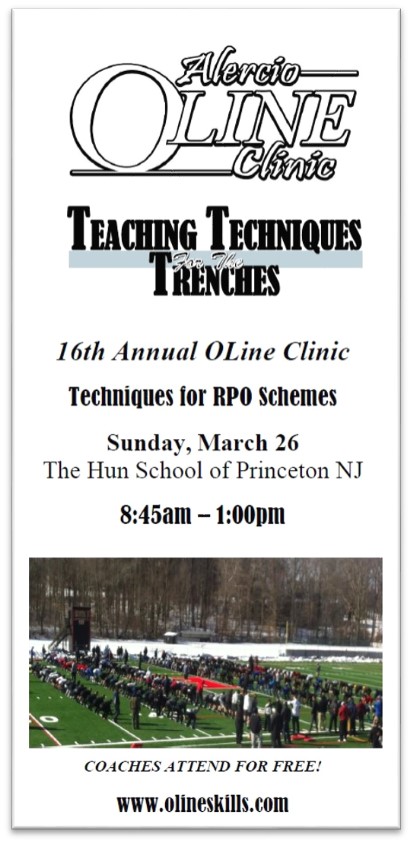
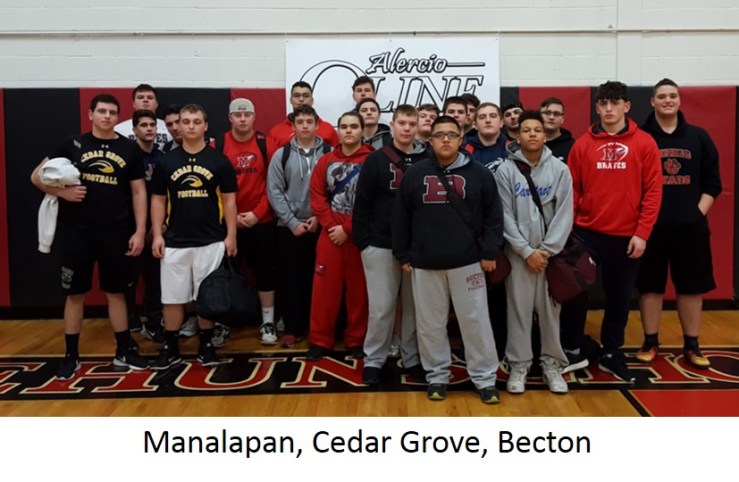
More than 200 offensive lineman representing over 40 high schools in 2 states along with dozens of their coaches made the annual pilgrimage to the 16th Alercio OLine Clinic on Sunday, March 26.

We spent 4 hours at the Hun School of Princeton learning and drilling 2 & 3-pt stances, 5 Run Steps, 2 Pass Steps, Run & Pass Punches, Targets and Strike Points, Drive Blocks, Down Blocks, Jump Sets, 4 Pulling Techniques, Combination Blocks, Double Teams, Pass Sets, 3 Run Blocking Schemes (Man, Zone & Gap) and Slide Protection.

Players and coaches both enjoyed the day, the team building, camaraderie and a chance to learn new techniques and improve skills.

If you’d like more info on the clinic, techniques, or how you could have Coach Rich Alercio teach his “Techniques for the Trenches” clinic at your school, please email Coach Alercio

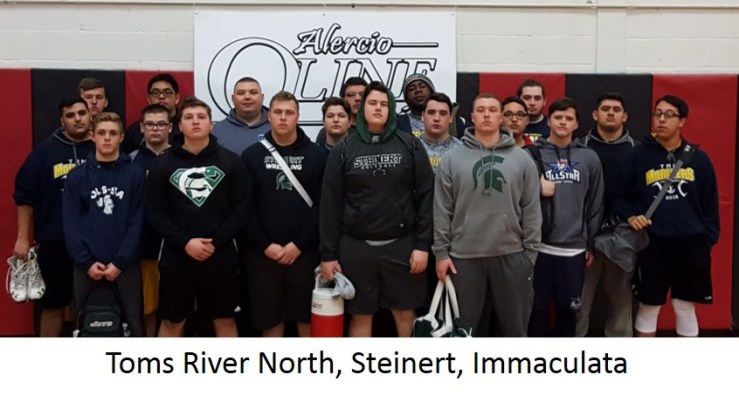
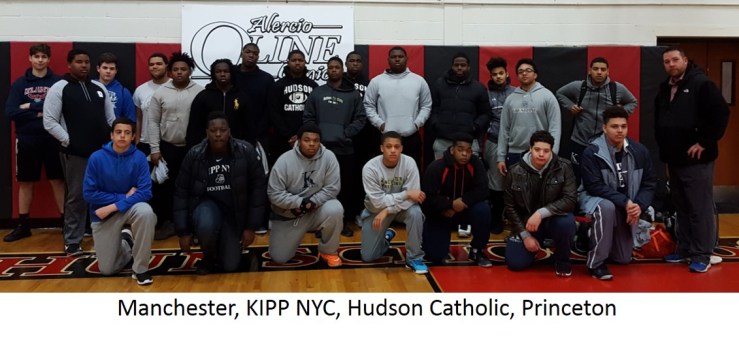
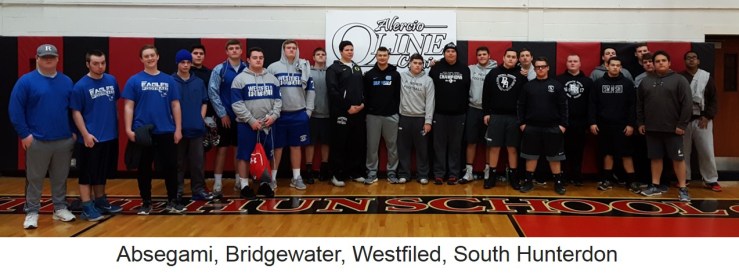
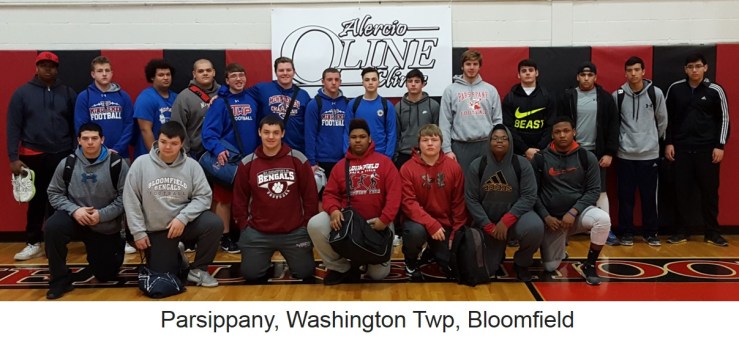
Check out some of the participants below:


1-Manalapan, Cedar Grove, Becton
2- Toms River North, Steinert, Immaculata
3-Manchester, KIPP NYC, Hudson Catholic, Princeton
4-Holy Cross, Delran, Central Regional, Ewing
5-Absegami, Bridgewater, Westfiled, South Hunterdon
9-Montclair, Hamilton West, Manasquan, Old Bridge, Ocean City, Pope John Paul II
8-Paulsboro, Montgomery, Belleville, Columbia, Nottingham
7-Shabazz, Rahway, Manville, Somerville
6-Parsippany, Washington Twp, Bloomfield
oline-clinic-cover-shot

Why Young Coaches Should Think Twice Before Leaving for a Promotion…

St. Johnsbury (Vt.) head coach Rich Alercio remembers receiving the same advice years ago that many young coaches still hear today: “To move up the ladder, coaches always need to keep an eye on their next step up…”  (or should they???)

Alercio heard that coaches should seek a new position every two-to-three years. He took the advice, leaving a job where he was comfortable—but finding his new role unfulfilling, even though it came with the allure of slightly more money and great responsibility.

It was a decision that Alercio regrets, and one that he hopes today’s young coaches can learn from.

“If you find a good job, where you like it, you’re learning and growing, stay there,” Alercio said, during an appearance on the USA Football Coach and the Coordinator podcast.

Though Alercio’s career eventually got back on track, he’s quick to encourage young coaches to think twice about leaving a good situation, particularly if the current environment promotes a healthy work-life balance.

“It’s a heck of a lot easier balancing life, family and happiness when you have a good job and you stick with it,” he said.

To listen to Alercio’s full interview on the USA Football Coach and the Coordinator podcast with Keith Grabowski, click here: Coach Rich Alercio on “The Coach & Coordinator Podcast”

“Innovations for Any Offense” eClinic- 

Live today March 20th, check out Coach Alercio’s eclinic on Innovations for any Offense

Click here: Coach Rich Alercio’s Glazier eClinic 


Don’t Miss The 16th Alercio OLine Clinic 

Sunday, March 26th 2017
Download your brochure:

OLine Clinic Brochure

oline-clinic-cover-shot


Building an Offensive Line: Offseason Mental Conditioning

Coach Rich Alercio believes in coaching the offensive line as the head coach.

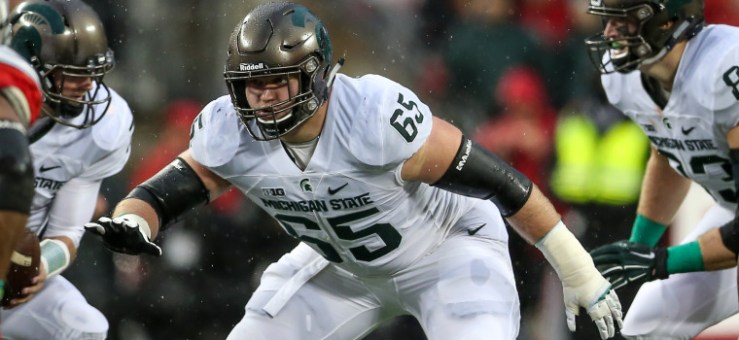
11.21.15_MSU FTBL VS OHIO STATE

Coaching the OLine is something Coach Alercio has done as an assistant, as a coordinator, and head coach. He attributes offensive success to the five interior players. Coach Alercio also believes that the group must work nearly year-round to develop the communication and chemistry that they need for game day excellence.

To do this, Alercio has developed an offseason, offensive line mental conditioning program. For Alercio, this breaks down into three areas: footwork, fit, and communication.

Alercio began utilizing this system because he found that there was little continuity when the player has five months off before they perform their skills again.

“There’s no carryover,” Alercio said.  “The player will think, ‘I remember we did something like this,’ but it doesn’t have the effect of doing it with regularity.”

The setup of these sessions is relatively simple, and the linemen can do it in a relatively small space using chairs as the defense.

Alercio gives the center the responsibility of setting these sessions up and moving the rest of the unit through.

The center will be responsible for changing the fronts and always makes the first call. The other linemen work on their communication and on cadence. They will step to their assignments.

This does not have to be a full speed drill. The emphasis is on the communication and mental work of assignment, correct steps, and fit to where the block belongs.

Alercio offered these tips for a successful mental conditioning session:

Give the center something to work off of. This could be a script or simply a list of fronts and defenses to work against a single concept.  After performing a set number of reps each way, the center will have the unit move the chairs. For example, they should work against four down front, then a three down front. The shade and 3 technique can be varied on each side, or linebacker alignments can be varied as well. Communication is the key. The older players should ensure that the younger players are being coached. Teaching a concept helps solidify understanding for both players.

Alercio feels that this is a good bridge from the beginning of the offseason to the spring.  Following the spring, the coaches are allowed to do more work with the players, and this carries into the summer.

The work then begins to become more physical, but a solid foundation of mental understanding has been established.

Read the original Offseason Mental Conditioning Post at USAFootball: Click Here!

Don’t Miss The 16th Alercio OLine Clinic March 26th 2017.
Download your brochure:
OLine Clinic Brochureoline-clinic-cover-shot


Rich Alercio on USA Football.com

Coach Rich Alercio was recently featured in articles on USA Football.com.

Check  out the articles:

Rich Alercio is confident in his run-pass option (RPO) pin and pull scheme no matter what defense he’s facing. The head coach of St. Johnsbury Academy (Vt.) recently joined the USA Football Coach and Coordinator podcast, where he broke down why he thinks the play is a nightmare to defend. Read the full article: Pin & Pull on usafootball

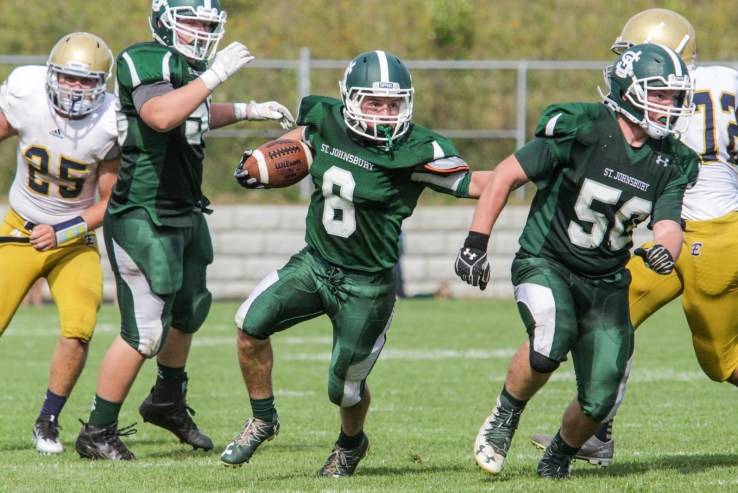
shane-run-v-essex-2

Get the Pin & Pull details you need to run this unstoppable offense! Click here: PIN & PULL on Coach’s Edge Marketplace

Install and call it.  5 star review 🏈🏈🏈🏈🏈.  Learn the details of the pin and pull concept packaged with 2 RPO companions. The ultimate Coaches Coach.  You’ll get the installation, diagrams, practice drills and a video reference tool that you can use all season long.

A Contrarian View on a Football Coach’s Ladder to Success

St Johnsbury Academy Head Coach Rich Alercio talks about why the most common advicecoaches-mentoring for building a coaching career may not be the best…
Read the full article here: Think Twice!

The grass may not always be greener…

Contact Coach Rich Alercio at: richalercio@gmail.com

Don’t Miss The 16th Alercio OLine Clinic March 26th 2017.

Download your brochure:

OLine Clinic Brochure

oline-clinic-cover-shot

Pin & Pull and The Run Pass Option

I recently did a Podcast on the Coach and Coordinator Show with Keith Grabowski.  Following great response from PodCast listeners, Keith invited me to do a F.A.S.T. Clinic Podcast (Focused Attack Strategies & Tactics) powered by Coaches Edge Technologies available in February. The topic is our Pin & Pull concept and the Run Pass Option (RPO) off of it. I’ll be sure to post updates as soon as they are available.  The following is an article relevant the clinic, and one I hope will whet your appetite for more.

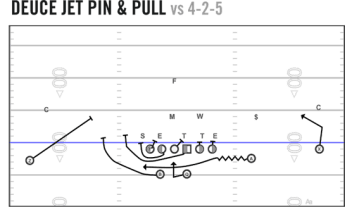
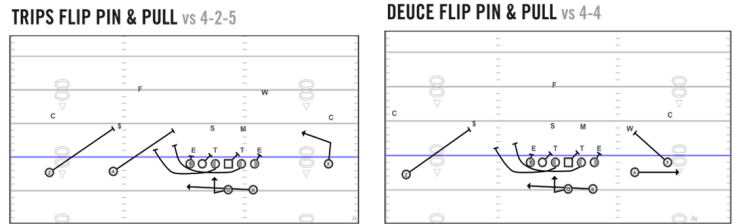
An age-old concept run in a shotgun spread offense, our Pin & Pull scheme is a knock off of the old “Packer Sweep” and the Wing T “Buck Sweep.”  But instead of just running it to the Left or Right Halfback we call it to our Running Back (B), Quarterback (Q), Flankerback (Z) and Slotback (A).  And when we call it to the Quarterback we incorporate an RPO (Run Pass Option).  This allows us to show defenses multiple play looks with one easy to teach and learn line scheme.  We also incorporate a pre-snap pass option on the backside of all of our Pin & Pull plays.  A single wide receiver on the backside has an option route of a Slant, Hitch, or Fade while multiple backside receivers run Bubble or Smoke Screen. Simple repetitive roles and responsibilities for our offensive players translate into multiple combinations and confusion for the defense.

trip-flip-and-deuce-flip

deuce-jet-pin-and-pull

We incorporate Zone and Man schemes in our offense and have found the Pin & Pull Gap scheme is easiest to teach to our players and they relay it is easiest for them to learn.  Every offensive lineman has the same rule:  If you have a defensive lineman in your backside gap, block him (Pin).  If not, Pull.  For those linemen who are pinning, it does not matter if the defender is on you, in your backside gap or on an adjacent offensive lineman.  We incorporate the same steps, visual targets, and strike points.  If we are running Pin & Pull to the Right, all Pinners will take a Bucket step with their left foot (backside foot).  The visual target is the near pec (or near number), and the strike points are the near shoulder (right hand) and sternum (left hand). This allows us to open our hips to the defender and screen him from his pursuit to the playside.  Pullers will step with their right foot (playside foot).  Playside pullers are looking to get outside.  Backside pullers must eyeball Inside Linebackers for penetration on split reads on their way to the outside.  In teaching our pullers to make contact with linebackers in space, we use the same terms we teach for openfield tackling: Run to, and Buzz.  At the college level, we used to throw inside shoulder to outside leg with a cut and roll technique to see the offensive lineman did not whiff (miss) in space versus an often more athletic second level defender.  At the high school level, we buzz our feet to breakdown in space.  For contact, the visual target is the sternum and the strike points are the pecs.

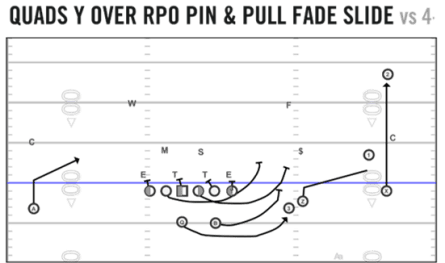
Unlike most RPOs where the defender being read is left unblocked, we block everyone in our QB Pin & Pull but include the RPO to take advantage of a defender who leaves his coverage responsibility for run support.quads-y-over-rpo We prefer using the Pin & Pull scheme for our RPOs for two reasons: 1) we do not have to tweak the scheme in any way for the RPO and 2) the blocking scheme limits risk of an ineligible man downfield on the pass.  With linemen either blocking on the Line of Scrimmage or Pulling to the outside, the QB has ample time to make the throw with no concern of having a lineman downfield.
We use a variety of 1, 2, and 3 man route concepts with our QB Pin & Pull RPO, but our favorite is our 2-man Fade-Slide out of an unbalanced Y Over formation with a pre-snap option route on the backside.  The option route gives us a pre-snap option if defenses overload to the unbalanced Y Over.  The post snap read starts with the overhang player (Outside Linebacker or Strong Safety).  If he abandons his coverage responsibility for run support, we throw the Slide route to our Slot receiver.  If the Corner squats on the Slide route, we have the ability to throw the Fade.  When the overhang player stays in coverage, the QB runs the ball in the alley.

I hope you’ve enjoyed this discussion of the Pin & Pull and RPO strategy we’ve employed to such success. I encourage you to listen to my interview on  Coach and Coordinator Show, and to bring your linemen to the Coach Alercio OLine Clinic at the Hun School this coming March!

Teaching & Drilling the Screen & Draw Game

This Martin Luther King Day, January 16, I will be speaking at Championship Football Clinics 18th Annual Offensive Line Clinic along with John Peterson, University of Pittsburgh, Justin Frye, Boston College, Allen Mogridge, Florida International, AJ Blazek, Rutgers University & Rich Hargitt, Eastside HS, S.C.

The clinic begins at 8am and is located at the Knights of Columbus, 79 Pascack Rd Washington Twp NJ. 2 miles from Bergen Catholic, High School

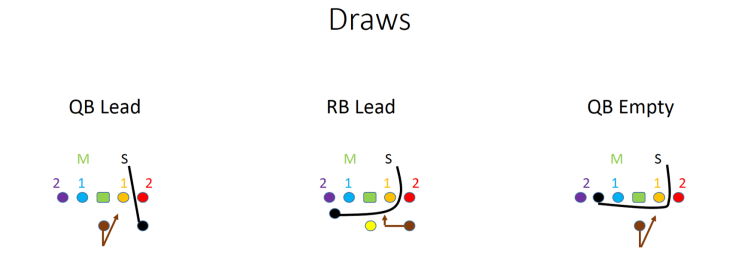
My topic is Teaching and Drilling the Screen and Draw Game.  Our Draws are 3 different plays but only 1 Scheme.  We run a QB Lead Draw, a QB Draw in Empty with a Pulling Tackle and a RB Lead Draw.  All three Draws are blocked the same with only one exception…the person assigned to block the Sam (1st playside LB).   The Tackles block #2 on the LOS (DE), Guards block #1 on LOS (DT or NG) and the Center blocks Mike (Middle or Backside LB).  Center will combo with either Guard if their #1 is in his path to Mike.  On our QB Lead Draw, the running back isolates the Sam.  We have our H-Back block the Sam on our RB Draw.  We pull the backside Tackle to block the Sam on our QB draw in Empty and align the TE next to him to cut of his #2.

draws

Draw is a running play so all of the offensive linemen can run block the scheme; but to create larger holes and encourage defensive linemen to displace themselves, we want our linemen to Jump Set any defensive linemen in an outside alignment (examples: Tackle vs a 5 tech or Guard vs a 3 tech).  On our Jump Set, we teach the offensive lineman to take a Base Run Step with his inside foot; and show a pass set with his upper body.  The “High Hat” of the pass set gives the DL a false read of pass and gets him in to a pass rush and away from the point of attack.  The Base Run Step with the inside foot defends the play in case of the DL being on an inside rush or slant.

We drill three scenarios in our Jump Sets.  When the DL gets upfield in a pass rush, we Club & Ride.  Our visual target is the near Pec.  We hold the set position until the rusher gets hip-to-hip then we turn towards him to club & ride him upfield.  The strike points are outside hand to near shoulder and inside hand to spine.  We are looking to club the middle of the back just below the shoulder pads.  On the ride, we want to be underneath the rusher so that he cannot retrace his steps when he recognizes Draw.    The next scenario is a DL who does not rush, but rather sits and reads.  After our Jump Set and the recognition that he is not rushing, we get in to an Angle Drive Block with a visual target of the near Pec and Strike points of near shoulder with the inside hand and sternum with the outside hand.  The last scenario we drill is the DL on an inside rush or slant move.  We must recognize the threat to our inside immediately and get in to a Vertical Drive Block to stop any inside penetration with a visual target of the sternum and strike points on both pecs.

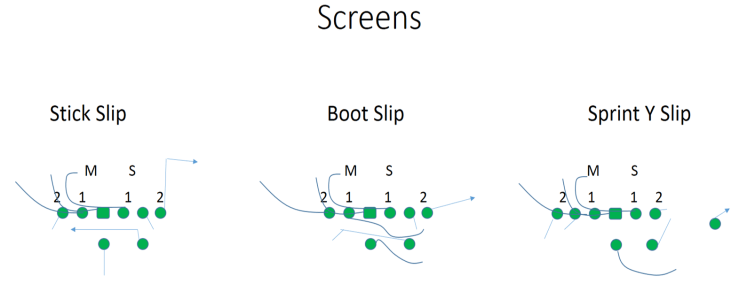
Our Slip Screens are 3-man, 2-count screens to the RB or TE and are run off of plays in our offense with NOW throws.  This allows us to run all of our screens as Screen Pass Options (SPOs).  Just like an RPO, we will identify a defender and read him as to whether we throw the Now throw of the pass play or turn to throw the screen.  This also sells the screen when we do throw it because the receivers are running routes and the QB has his eyes on a route opposite the screen.

screens

On our Stick Slip, we read the Sam to throw the Stick route to the TE or Slip Screen to the RB.  On our Boot Screen, will read the Sam to throw our TE Pin Flat or RB Slip.  On our Sprint Y Slip, we throw a slide route to our Slot Receiver or a Slip to the TE.

On all of our Screens we block the protection of the play for a 2-count so there is no new teaching.  After the 2-count, three linemen will depart to the edge of the box on the screen side.  The first one looks Out, the second looks Up and the third looks In.  On our Stick Slip and Sprint Y Slip, the two Guards and Center pull out on the Screen.  Since we pull a Guard in our Boot protection, on our Boot Slip, we pull the Screen side Tackle, Center and Playside Guard out on the Screen.  The other two linemen stay in their protection.

The technique we teach and drill on Screens for the offensive linemen is to Run (Out, Up, or In), Buzz (feet before contact) then block.  On the block the visual target is the sternum and the strike points are the pecs.  We buzz our feet to get the offensive lineman under control before making contact.


Two Coaches Meet…

Two coaches meet. Each has a penny.

They exchange pennies and go their separate ways.

Each still only has one penny.

Two coaches meet. Each has an idea.

They exchange ideas and go their separate ways.

Each now has two ideas…

I have coached offensive line as a Graduate Assistant, Assistant, Coordinator and Head Coach at the college Division II and III levels for over 25 years. I am now a high school head coach and still coach the offensive line. During my career, I have had the good fortune of working with and learning from some of the top OLine coaches in the country. As a Glazier and Nike speaker, and an original contributor to XandO Labs, I have had the pleasure of sharing those things we have done successfully with thousands of coaches. Through the Alercio OLine Clinics I have run in New Jersey, Pennsylvania, Maryland and Vermont over the past 16 years, I have shared OLine Skills with over 7,000 high school aged linemen and hundreds of their coaches.

As an undersized offensive lineman in high school and college, I learned the importance of good technique in order to have success. As a coach, I have spent a career studying those techniques so that my players can maximize their individual, and our team’s success. I know, as a father of three boys, that most boys can run with a ball in their hand, throw, catch, and tackle; but they do not come out of the womb being able to run or pass block. Those are learned skills that have to be learned and mastered over time.

I began my coaching career with the goal of having the same positive impact on young men that coaches and mentors had on me. Nike, Glazier and other venues have given me a local platform to share with colleagues and now I want to share what I have learned more broadly. Despite recent success helping St Johnsbury Academy reach the state finals in two of the last three years, and winning more games in three seasons than in the prior eight combined, I know I have plenty to learn.

As I have told players for many years, “the hand that gives gathers.” This blog is intended to share ideas, spur conversation, and broaden the knowledge, skills, and abilities of the coaching fraternity. I hope you find it useful and look forward to a healthy and positive exchange of ideas.

Here’s to a great season with a great team,
Rich